
This guide explains Amazon to Amazon flips and how they work, for sellers looking to understand this sourcing method and decide whether it fits their Amazon business.
What Are Amazon to Amazon Flips? (A2As)
A2As are a form of online arbitrage on Amazon where sellers take advantage of temporary price drops on Amazon and resell the same products on Amazon once prices recover.
These short-term pricing inefficiencies occur regularly due to Amazon's automated repricing systems, sudden stock changes, competitive pressure, listing errors or simple human mistakes. In many cases, historical pricing data shows the drop is an anomaly rather than a genuine shift in market value.
Instead of predicting future demand, sellers analyse price history to identify when a product is temporarily underpriced. Once the conditions causing the suppressed price resolve, the listing often returns to its normal range, allowing sellers to profit from the correction.
Why Amazon to Amazon Arbitrage Exists
Amazon pricing is the result of thousands of independent systems reacting to each other at the same time, not a single, perfectly controlled engine. Amazon Retail, third-party sellers, Business pricing, Buy Box logic, and automated repricers all adjust prices in real time, often within seconds.
These systems can prioritise speed over precision causing short-term pricing imbalances to naturally occur. Inventory clearances, automated price matching and stock outages can all temporarily push a product below its typical market range.
For many products, long-term pricing remains relatively stable, with brief dips that quickly correct once conditions normalise. When demand still exists, prices often rebound, which is what makes Amazon to Amazon arbitrage repeatable rather than random.
A Simple Way to Think About Amazon Pricing Mistakes
Hypothetically, say Amazon processes 5–15 million product price changes per day across its marketplace.
If even 1% of those changes result in a temporary misprice caused by repricers, stock issues, or algorithm delays, that's:
- 50,000–150,000 temporary pricing gaps per day
Now assume that only 1% of those gaps are actually usable once you factor in fees, competition, Buy Box stability, and stock limits.
That still leaves:
- 500–1,500 genuine Amazon to Amazon flip opportunities every single day
These pricing gaps usually last minutes or hours, not days, which is why speed and data matter more than manual searching. Amazon's pricing systems don't "break", they simply move too fast to be perfectly efficient at all times, and those small inefficiencies are what A2A sellers take advantage of.
Why Amazon to Amazon Flips Are So Popular
Amazon to Amazon flips remove many of the friction points found in traditional arbitrage. This method can be a simple beginner friendly way to get started in online arbitrage.
Key advantages include, no physical retail sourcing, potential faster turnaround from purchase to sale, predictable pricing behaviour using historical data and easier scaling with automation.
With everything happening within Amazon, sellers can focus on speed and execution rather than logistics.
How Amazon to Amazon Flips Work With ArbiSource
Amazon to Amazon arbitrage is highly competitive and extremely time-sensitive, which makes manual sourcing a major limitation. Without software like ArbiSource, sellers are restricted by how many products they can analyse, how quickly they can react to price changes and how confidently they can validate whether a price drop is genuine or temporary. ArbiSource removes these constraints by continuously monitoring Amazon, validating price behaviour using data, and surfacing real opportunities in real time so sellers can act before the window closes.
With ArbiSource, you can:
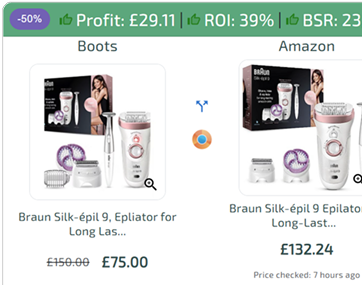
- Find standard Amazon to Amazon flips across Amazon Retail and third-party sellers.
- Source Business A2A flips, where bulk buying unlocks higher margins.
- Automatically reverse-search every A2A lead to find alternative retail sources.
- Confirm whether Amazon is genuinely the cheapest option or reacting to another retailer.
- Receive instant Discord notifications for the exact Amazon to Amazon flips you want.
Why Reverse Retail Searching Is a Major Advantage
This is where the true power of ArbiSource A2As step in, because of our product scanning on other ecommerce websites. You can unlock stock from other retailers at discounted prices to buy up and resell on Amazon.
Is Amazon to Amazon Arbitrage Allowed?
Yes, Amazon to Amazon arbitrage is allowed when done correctly.
Sellers must:
- Take possession of the inventory
- Follow Amazon seller policies
- Sell authentic products
Amazon to Amazon flips are not dropshipping. You are acting as a legitimate reseller within Amazon's ecosystem.
Is Amazon to Amazon Arbitrage Profitable?
Amazon to Amazon flips focus on small, repeatable margins rather than high-risk products.
Many sellers prefer A2A arbitrage because:
- Demand already exists
- Pricing behaviour is measurable
- Inventory can move quickly
- Capital can be recycled faster
With the right Amazon arbitrage software, Amazon to Amazon flips can become a consistent sourcing channel. Understanding profitability is key to making money on Amazon, and A2A is one of several business models sellers can choose from.
Who Are Amazon to Amazon Flips Best For?
A2As are well suited to both new and experienced sellers who want a simple, fast-moving arbitrage model. They’re ideal for sellers learning the basics of arbitrage, those seeking quick inventory turnover, and anyone who wants to avoid physical retail sourcing altogether.
Source Deals Like A Pro
7 Day Free Trial
FAQ
What does A2A mean in Amazon arbitrage?
A2A stands for Amazon to Amazon arbitrage, where products are bought and resold on Amazon at different prices.
How long do Amazon to Amazon flips last?
Many A2A flips last only hours or days, which is why alerts and automation matter.
Are Amazon Business A2A flips different?
Yes. Business A2A flips often include bulk pricing and quantity discounts that increase margins.
Do I need software for Amazon to Amazon flips?
Manual sourcing is possible, but most sellers use Amazon arbitrage software to compete on speed and scale.