
If you're new to arbitrage Amazon selling, one of the first decisions you'll face is whether to focus on online arbitrage (OA) or retail arbitrage (RA). Both models involve buying low and selling high on Amazon, but the way you source products is very different.
This guide compares online arbitrage v retail arbitrage, explains the pros and cons of each and shows how ArbiSource can support both approaches. Both are methods for making money on Amazon.
Quick Answer: Online Arbitrage vs Retail Arbitrage
Online arbitrage involves buying discounted products from online retailers and reselling them on Amazon for a profit.
Retail arbitrage involves buying discounted products from physical stores and reselling them on Amazon.
The main difference is how products are sourced. Online arbitrage is more scalable and data-driven, while retail arbitrage is more hands-on and location-based. Many Amazon sellers start with retail arbitrage to learn the basics, then move into online arbitrage to scale.
Best for beginners: Both work. Retail arbitrage teaches fundamentals faster, while online arbitrage scales more easily long term.
What is Online Arbitrage?
Online arbitrage involves buying products from online retailers and reselling them on Amazon.
A simple example:
You see a LEGO set online for £10 because it's on sale.
The same LEGO set is selling on Amazon for £20.
You buy it for £10, sell it on Amazon for £20, and keep the difference after fees.
That's online arbitrage.
Online arbitrage starts by sourcing products from websites where items are discounted, mispriced, or temporarily cheaper than their usual selling price. Once you buy the product, it's either shipped directly to your home or to a prep centre that checks, labels, and prepares the inventory for sale.
From there, the items are sent into Amazon FBA, where Amazon stores the products, ships them to customers when they sell, and handles customer service and returns on your behalf.
Online arbitrage is popular because it's scalable and repeatable. Once you find a process that works, you can run it again and again without starting from scratch. Everything is done online, so there's no need to travel to physical stores, saving both time and money.
Because OA relies heavily on analysing prices, demand, and competition, it's also much easier to automate with software. This is why most larger sellers treat online arbitrage as a data-driven sourcing model. For detailed methods and strategies, see our guide on finding products for online arbitrage. You can also compare online arbitrage to wholesale to understand different sourcing models.
What is Retail Arbitrage?
Retail arbitrage involves buying products from physical stores and reselling them on Amazon.
Simple example: you buy a toy in a shop for £10, sell it on Amazon for £20, and keep the difference.
Retail arbitrage starts by visiting high street or big-box stores to look for discounted or clearance products. While in the shop, sellers scan items using a mobile app to check Amazon prices, fees, and potential profit in real time. If the numbers make sense, they buy the products and send that inventory to Amazon FBA.
Retail arbitrage is more manual and time-intensive, but it can uncover opportunities others miss, particularly local or store-specific clearance deals.
Now that the basics of each model are clear, the real differences come down to how fast you can source and how easily you can scale.
Online Arbitrage v Retail Arbitrage: Key Differences
Understanding the differences between online arbitrage and retail arbitrage makes it easier to choose the approach that fits your time, resources, and long-term goals.
Sourcing speed
OA: Fast, large-scale product lists
RA: Slower, one product at a time
Scalability
OA: Highly scalable with automation
RA: Limited by time and location
Competition
OA: More sellers see the same retailers
RA: Location-based deals reduce competition
Data and analysis
OA: Relies on software and filtering
RA: Relies on mobile apps and judgement
Lifestyle fit
OA: Remote and desk-based
RA: Physical and store-based
Capital Requirements & Cash Flow
One of the biggest practical differences between online arbitrage and retail arbitrage is how capital is used and how quickly it comes back.
Retail arbitrage often allows sellers to start with smaller amounts of money. Because purchases are made one product at a time and inventory is usually sent to Amazon quickly, capital can cycle faster in the early stages. However, scaling is limited by how much stock you can physically source and transport.
Online arbitrage typically requires more upfront capital, especially when buying multiple units from the same retailer or running larger sourcing batches. In return, OA offers smoother cash flow over time because sourcing can be repeated, scaled, and planned more predictably.
As sellers grow, many move toward online arbitrage because it allows them to deploy capital more efficiently across larger product lists, rather than tying time and money to individual store visits.
Which is Better For Beginners?
This comes down to personal preference and the factors discussed above. Some beginners prefer online arbitrage because it can be done from home and is easier to systemise, while others learn faster with retail arbitrage by physically seeing products, prices, and demand in real time.
There's no right or wrong choice. The best option is the one that fits your budget, schedule, and learning style.
Many sellers end up using a blend of both models over time. It's common to start with retail arbitrage to learn the basics, then move into online arbitrage when the goal shifts toward scale and efficiency.
The reason beginners experience each model differently comes down to how the learning curve works in practice.
Learning Curve Differences Between OA and RA
Retail arbitrage often teaches fundamentals faster because sellers see products, prices, and demand in real time. Beginners quickly learn how sales rank behaves, how competition affects pricing, and how Amazon fees impact profit on individual items.
Online arbitrage shifts the learning curve toward data interpretation. Sellers learn how to filter large product lists, analyse price history, validate demand at scale, and avoid short-term pricing spikes. While this can feel more complex at first, it becomes significantly more efficient once systems are in place.
Seasonality & Deal Consistency
Retail arbitrage opportunities often follow retail cycles. Clearance events, store resets, and seasonal promotions can create strong short-term opportunities, particularly around Q4 and major sales periods. Outside of these windows, deal flow can slow significantly.
Online arbitrage benefits from year-round pricing volatility. Discounts, mispricing, automated repricing errors, and temporary stock shortages happen continuously across online retailers. This makes OA more consistent over time, especially for sellers who rely on steady sourcing rather than seasonal spikes.
For sellers aiming to build predictable workflows, online arbitrage generally offers more stability once sourcing systems are established.
Risk & Reality Of Each Model
Both online arbitrage and retail arbitrage come with risks, but those risks tend to show up in different ways.
Retail arbitrage risks often relate to sourcing conditions. Products may have damaged packaging, missing receipts, or clearance stickers that cause issues during prep or returns. Availability is inconsistent, and once a deal is gone, it's often gone for good. There is also the physical cost of time, travel, and storage when sourcing regularly.
Online arbitrage risks are usually data-driven. Prices can drop suddenly if multiple sellers find the same deal, and some retailers cancel orders or limit quantities without warning. Because many sellers can access the same websites, competition can increase quickly if a product isn't validated properly using historical data.
Understanding these risks doesn't mean avoiding either model. It means building systems that reduce avoidable mistakes.
Tools Used For Online Arbitrage & Retail Arbitrage
Both online arbitrage and retail arbitrage rely on tools to reduce guesswork, speed up decisions, and protect profit, but the systems used differ based on how products are sourced.
Online arbitrage tools are built around speed, scale, and automation. Sellers use sourcing software to scan thousands of products across multiple websites, looking for price gaps and profitable opportunities. Profitability and fee calculators help estimate Amazon fees, ROI, and net profit before buying. Restriction and gating checkers confirm whether a product can be sold, while alerts notify sellers when prices or stock levels change. Online arbitrage sellers may also explore Amazon-to-Amazon flips as part of their sourcing strategy.
Retail arbitrage tools are more hands-on and designed for use in-store. Most sellers rely on mobile scanning apps such as the SellerAmp, Amazon Seller App or Scoutify to scan barcodes and instantly see prices, fees, sales rank, and competition. Price history tools like Keepa help judge demand and avoid short-term spikes.
As sellers grow, many use a blend of both toolsets to combine in-store sourcing with data-led decision making. For more on Amazon seller tools and building a complete tool stack, see our comprehensive guide.
How ArbiSource Supports Online Arbitrage
ArbiSource helps online arbitrage sellers by turning manual research into structured workflows.
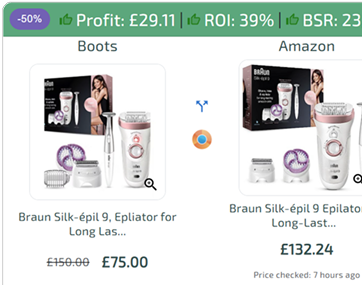
Sellers can scan retailers and Amazon categories, filter opportunities by ROI, margin, and demand, check restrictions automatically, and scale sourcing using repeatable processes.
Instead of browsing websites one product at a time, sellers work from large, filtered data sets that highlight worthwhile opportunities.
If you want to explore how ArbiSource supports online arbitrage in more detail, the following sources break down specific use cases and workflows:
Explore ArbiSource Features
For a full overview of the ArbiSource features available, check out the feature section on our homepage.
Amazon-to-Amazon Flips
A focused breakdown of how ArbiSource is used to identify fast-moving A2A opportunities, temporary price drops, and lower-competition listings.
How to Find Products for Online Arbitrage
A practical walkthrough of using ArbiSource to surface arbitrage opportunities at scale instead of manually checking products one by one.
Using ArbiSource For Retail Arbitrage
While ArbiSource is an OA-first platform, it also supports retail arbitrage workflows.
Sellers can build in-store buy lists by identifying profitable products from retailers that also operate physical stores. These lists can then be used to hunt for clearance or discounted stock locally.
ArbiSource also integrates with SellerAmp, whose mobile app is commonly used during retail arbitrage.
A typical workflow looks like this:
- Scan products in-store using SellerAmp
- Reverse-search products using ArbiSource data
- Validate profitability and sourcing options on the move
This bridges online data with in-store sourcing.
Common Beginner Mistakes In Arbitrage
New sellers often make different mistakes depending on the sourcing model they choose.
In retail arbitrage, common mistakes include buying into short-term price spikes, ignoring product condition requirements, or failing to check restrictions before purchasing inventory. These errors often lead to stranded stock or unexpected returns.
In online arbitrage, beginners may rely too heavily on current prices without checking historical data, underestimate how quickly competition can enter a listing, or overlook retailer order limits and cancellations.
Regardless of the model, the most costly mistakes usually come from skipping validation steps. Consistent profitability comes from combining sourcing with reliable data, not speed alone.
Source Deals Like A Pro
7 Day Free Trial
FAQs
Is online arbitrage better than retail arbitrage?
Online arbitrage scales more easily, while retail arbitrage can offer unique local deals. The best choice depends on your goals.
Can beginners do both?
Yes. Many beginners test retail arbitrage while learning Amazon, then use online arbitrage to scale.
Do I need software for retail arbitrage?
Not strictly, but apps and data tools significantly reduce mistakes and improve profitability.
How does ArbiSource help retail arbitrage sellers?
It helps create buy lists from online data and integrates with mobile tools like SellerAmp for in-store validation.